 |  |
 |  |  |  |  |  |  |
|  | |||||||


| Histories.. History of languages region and civilization.. |
 |
| | Thread Tools | Search this Thread | Rating:  | Display Modes |
|
#1
 02-11-2009, 12:50 AM
| ||||
| ||||
 Kalash Valley: Where Fairies Dance and Sing; Kafir Kalash (The Wearers of Black Robe) Kalash Valley: Where Fairies Dance and Sing; Kafir Kalash (The Wearers of Black Robe) 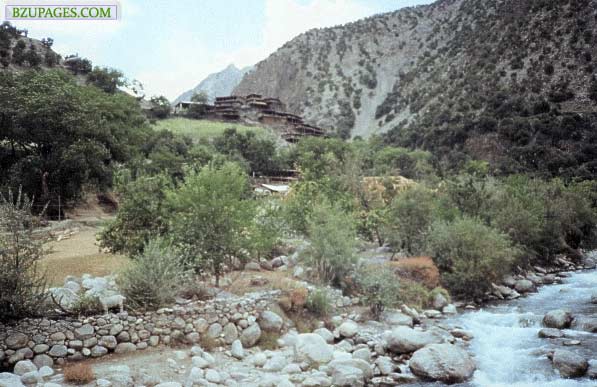 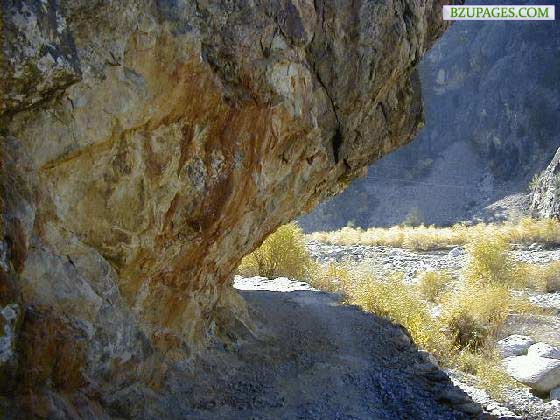 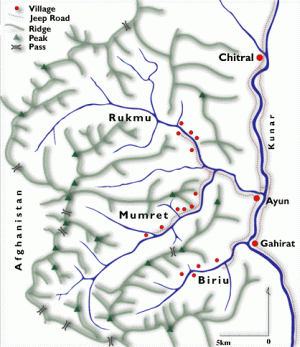 The villages are situated on the southern face of the hillside about 50-100 meters above the river. This protects them from invaders and the floods in summer, and at the same time helps to get sunshine during the winter. The snow that lies on the bottom of the ravine and in the shade do not melt until spring. In summer to avoid the sun, some people live in a second house built on the opposite side of the river. The Kalash Valleys have extensive forests of Holly-Oak and Himalayan cedar. Walnut, Apricot, Apple, Pear and Mulberry trees abound near the villages. 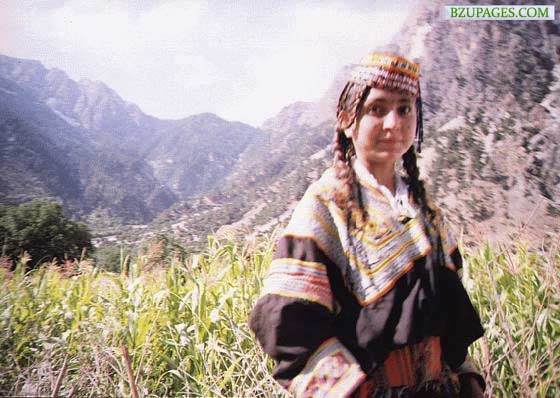 The Kalash women wear five large braids of and the 'Cheo', a black woolen homespun dress, red-beaded necklaces by the dozen, and an exceptional head piece (shaped differently in each valley) covered in cowrie shells, beads and trinkets that flow down their back. For their black robes, the Kalash are sometimes referred to as the "Wearers of the Black Robes". Kalash means black in their language.  Rudyard Kipling's "The Man Who Would Be King" is purported to be in the Kafir Kalash Valleys. In the late 19th century the present day Kalash Valley was known as Kafiristan -- Land of the Infidels -- and extended to several valleys in present day Afghanistan. However, the inhabitants of the Afghan Kafir valleys were forcibly converted to Islam, leaving only the tribes of the three valleys of Rambur Bumburet and Birir to carry on their centuries-old animistic culture. In order to conserve this primitive pagan tribe and to protect their distinctive identity, unparalleled in the world, the Government of Pakistan has officially forbidden anybody from trying to convert these tribes to another religion. 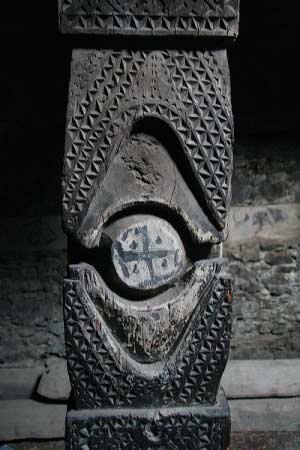 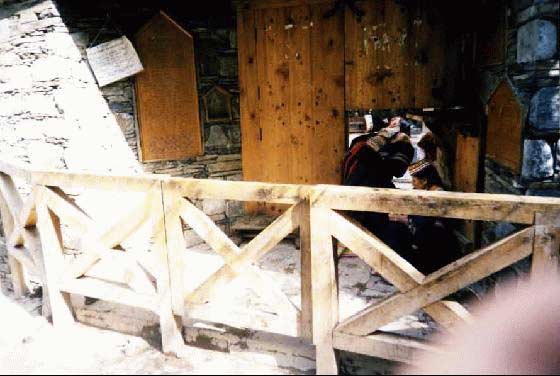 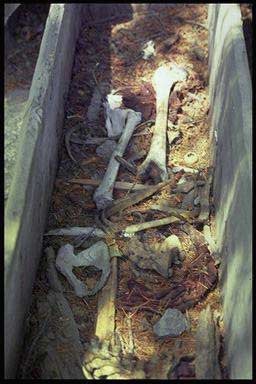 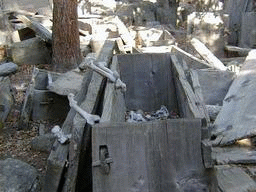 \\\\Their Graves//// 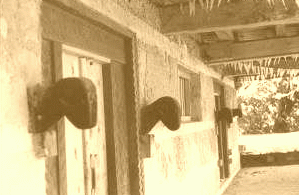 The Kalash tribes have their own distinctive religious and social traditions. The Kalash believe in God they call “Deziao”. However their religious practices are a mixture of animism and ancestor worship. Their god is represented in wooden effigy, while animal effigies represent their belief in animism. There is also a concept of male and female sacred spirits called “Dewalok” who are responsible for different activities and are believed to communicate prayers to Deziao. There is also a concept of pure-impure dualism in Kalash religion. The pure is called ‘Onjesta’- the pure – while women are considered Pragata- the impure. They leave their dead open in the coffins, even when the bodies have become mere skeletons (below left). They usually leave all of the belongings of that person next to their coffins. At nightfall, animals and other beasts of pray come down the mountains and eat up what remains of that dead while the belongings are carried away by other inhabitants in the area. The Kafirs end up believing that the deceased has gone along with his belongings. The Kalash graveyards are smelly for the obvious reason and the faint hearted should not go as they should expect to see unsuitable scenes. 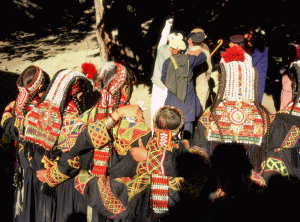 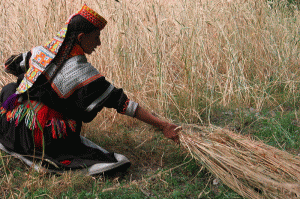 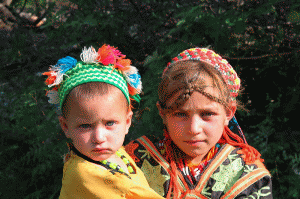 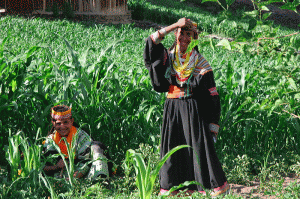 Kalash women adorned with make-up and their necks laden with bright orange and yellow necklaces, wear brightly coloured embroidered robes, which go very well with their rather fair colour and generally blue eyes. The women in Kalash are expected to treasure traditional knowledge. Yet when it comes to sitting around for a lunch or dinner, like many other agrarian communities, they are suppose to take a back seat, eat less and offer the better dietary constituents, like butter, milk and meat, to their brothers, husbands and sons. There are special laws for women. In the special days, women are sent to make shift made shelters (above centre), called "Bashali", till they are clean. There are also segregation rooms (above right) for expecting mothers. The Kalash believe that women in later stages of pregnancy are impure therefore they avoid getting into contact with them. For this purpose, these special rooms are built where such women live up to four months. All food and other necessities are provided to them during their stay, but care is taken in not touching the impure women. While visiting the holy places, care should be taken that altars and holy places could only be visited by male tourists not by females because women are not allowed to these sacred places and it is strictly forbidden for them. In addition, there are some places like Bashali, Bashalini (Menstruation House) where the males are not allowed... 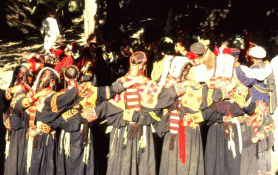 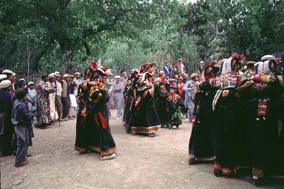 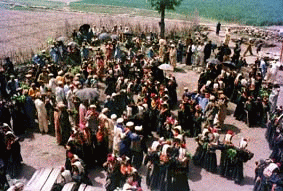 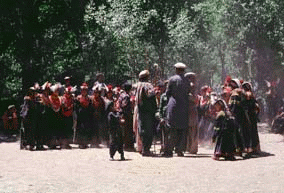 The Kalash are a friendly and cheerful people, who love music and dancing, particularly on their religious festivals like Joshi Chilamjusht (14th & 15th May in spring), Phool (20th-25th September) and Chowas (18th to 21st December). In the spring festival Joshi, autumn festival Uchao, weddings, funerals, feasts and on many other occasions the whole society of the Kalash gather and participate in a grand performance called cha, drajahilak and dushak. These are set performances all consisting of song (ghu), dance (nat) and the drums but the details differ respectively. 5 to 10 elders make a circle and one of them will sing alone, followed by a chorus. Besides them there will be one set of drummers, one playing a barrel shaped drum called dahu and the other a glass-hour shaped drum, wach. Around the elders and the drummers, 20 to 200 dancers dance while singing. 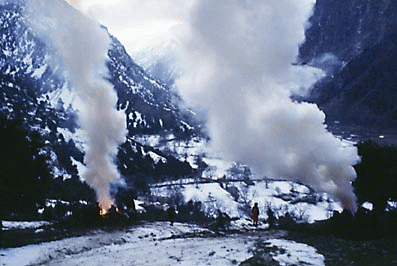 Chowas (or Choimus) Festival: Chowas is a winter festival celebrated to welcome the New Year. The entire population remains indoor. It is celebrated by feasting and merry making until the elders, who sit on a hill top, watching the sun reaching the orbit, then declare the advent of the New Year. Children go up to the mountain, where they divide into boys and girls, and respectively make a big bonfire. After singing songs for some time the fire will be extinguished and then the two groups will compete with each other for the size of the smoke that rises up in the air. Then they all go down the mountain and return to the village singing " songs of Sarazari" carrying branches cut down from the mountain top. The elders will be waiting chanting songs in the village. 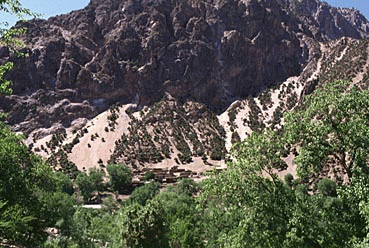 Joshi Festival: In the month of May, when the entire valley is cloaked in green, covered with the leaves of the walnut tree, it is time for Joshi. Everyone is waiting for the festival to start. Young ladies are busy preparing their dresses for this special day. The first day of Joshi is "Milk Day", on which the Kalash offer libations of milk that has been saved for ten days prior to the festival. 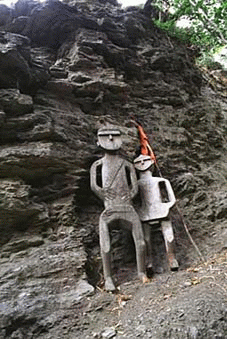 Pu Festival of Birir: When the walnuts and grapes are all collected and wine-making is done, it is time for Pu festival in Biriu. Guru is the first village you encounter in the valley and at the entrance of the next you shall meet the wooden statues gandaw. 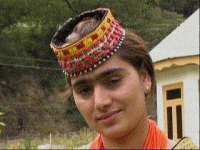 Visiting Kalash: The temperature of Kalash is very pleasant in summers and the best time to visit is between May and September if someone is planning a visit by road. For those using air link, one can extend it by another two months. The maximum temperature of Kalash valley in summers is between 23°C to 27°C and the mean minimum temperature is between 2°C to 1°C. In winters, the entire region in general and Kalash Valley in particular comes in the grip of cold northerly winds. The extreme minimum temperature recorded in the valleys have been -4.8°C to -15°C for the month of January and February. The valley get rainfall between 700mm to 800mm. From December to March occasionally even later, snowfall is quite frequent Kalash valley.
__________________ (¯`v´¯) `*.¸.*` ¸.*´¸.*´¨) ¸.*´¨) (¸.*´ (¸.Bzu Forum   Don't cry because it's over, smile because it happened Don't cry because it's over, smile because it happened   |
 .BZU.
.BZU.





|
| Tags |
| black, dance, fairies, kafir, kalash, robe, sing, valley, wearers |

« Previous Thread
|
Next Thread »
| Currently Active Users Viewing This Thread: 1 (0 members and 1 guests) | |
 Linear Mode

| |

 Similar Threads
 | ||||
| Thread | Thread Starter | Forum | Replies | Last Post |
| Dance Leaders Dance | usman_latif_ch | Audio/Video Section | 0 | 11-12-2010 05:11 PM |
| ~*~Small fairies~*~ | sadia | Designed Pictures | 0 | 25-09-2010 03:57 PM |
| Shirk: Reallity of Lal shahbaz qlander follower (kafir, mushrik) | .BZU. | Youtube Videos/Clips etc | 0 | 11-02-2010 10:44 PM |
| Tare Ore - Sing is king | shahidkhan | Video Songs (Direct/RS links) | 0 | 26-05-2009 11:42 AM |
| A story ...Men who are ungrateful should remember fairies are female..... | BSIT07-01 | Stories,Novels & Kahaniyan | 0 | 07-11-2008 11:05 PM |
Almuslimeen.info | BZU Multan | Dedicated server hosting
Note: All trademarks and copyrights held by respective owners. We will take action against any copyright violation if it is proved to us.
All times are GMT +5. The time now is 05:34 AM.
Powered by vBulletin® Version 3.8.2
Copyright ©2000 - 2026, Jelsoft Enterprises Ltd.
Copyright ©2000 - 2026, Jelsoft Enterprises Ltd.